DROTTNING KRISTINA – Sveriges mest makalösa regent.
A richly illustrated journey through the extraordinary life of Queen Christina of Sweden — from her childhood at the royal court and her years as queen to her dramatic abdication, conversion to Catholicism and new life in Rome.
History, art and storytelling come together in a book about one of Sweden’s most fascinating and unconventional monarchs — a truly makalös queen.
BOOK DETAILS
Publisher: Opponentförlaget
Age: 9–13 + adults
Pages: 34
Language: Swedish
Order here: Adlibris
Film: Jacob Papinniemi
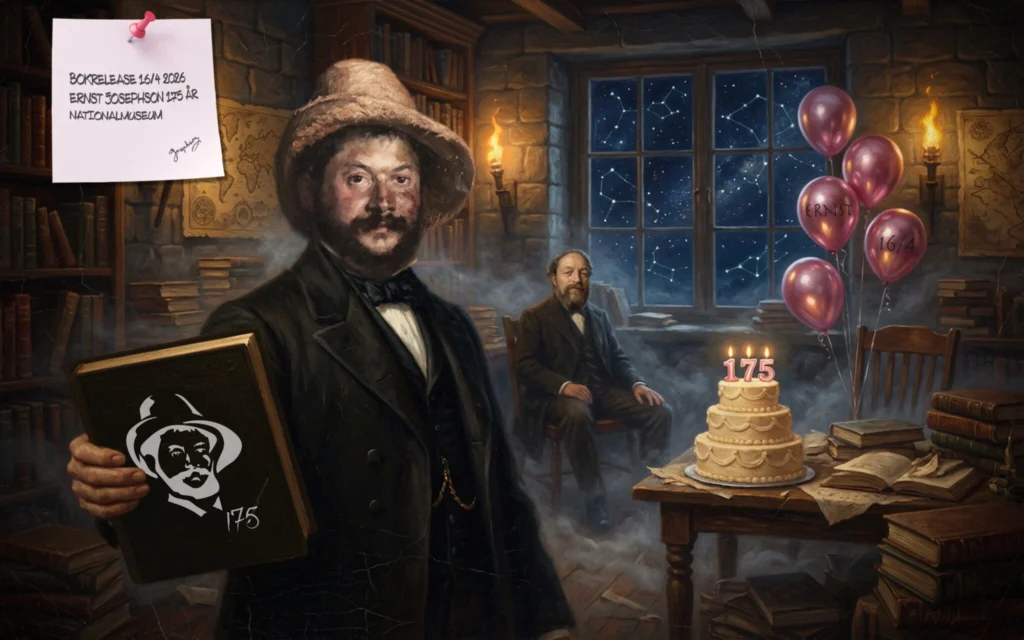
On 16 April 2026, the 175th anniversary of Ernst Josephson’s birth was commemorated with a jubilee edition of collected drawings and texts by his relative, Per Josephson.
For several years, I have been working on a series of drawings and accompanying texts that take their point of departure in Ernst Josephson’s Illness Drawings.
Thin lines on simple paper—whatever loose sheets the staff at Uppsala Hospital could find. Old advertisements, discarded account ledgers, and the reverse side of last week’s lunch menu would suffice as Ernst’s pen moved manically across empty surfaces.
On 29 December 1888, the artist Ernst Josephson was admitted to Uppsala Hospital and diagnosed with schizophrenia. The staff soon discovered that he grew calmer with a pen in hand and continuously supplied him with all manner of paper to fill. During his period of illness, Ernst produced several hundred drawings that today constitute an invaluable part of Swedish art history.
I grew up with these drawings, and some years ago I began a project in which, using the same simple paper and similarly delicate line work, I continue the work of the hospital drawings. Following a number of exhibitions—most recently at Opponentgalleriet in Stockholm—the series has now grown to more than one hundred works.
Initially, the project was directly connected to Ernst and his multifaceted life. Over time, however, its scope expanded to include many of his contemporaries: Carl Larsson, Anders Zorn, August Strindberg, and many others. The drawings survey one of the most transformative periods in Swedish cultural history, when influences from the great artistic capitals of southern Europe surged across the borders, the Opponents stood on the barricades to reform the weary Royal Academy of Fine Arts in Stockholm, and even King Oscar II was challenged in the name of art. The turbulent struggles and liberation of the late nineteenth century laid the foundation for an awakening and an entirely new understanding of art—indeed, of cultural practice and cultural consumption itself.
The jubilee edition, released on Ernst’s 175th birthday, will be published by Gidlunds. In 1988, Gidlunds published a selection of Ernst’s hospital drawings under the title Andeprotokollen (Protocols of the Spirit). The volume, entitled Vid himmelrikets portar (At the Gates of Heaven), featured a foreword by Peter Cornell. The drawings are entirely unique in their fusion of image and text, and it is of great significance to this project that Gidlunds once again stands behind the publication.
For this jubilee edition, David Dunér, Professor of History of Ideas and Science, has contributed a far-reaching afterword. Dunér is also Sweden’s foremost authority on Emanuel Swedenborg, an important connection given the central role Swedenborg played in Ernst’s worldview during his creative period of illness.
The jubilee edition, released on 16 April 2026, is numbered and signed, and may briefly be described as one hundred art-historical moments with a focus on the high-octane late nineteenth century.
The anniversary celebration will take place at the Nationalmuseum in Stockholm on 16 April 2026.
Get the Jubilee Catalogue here: Jubilee Catalogue