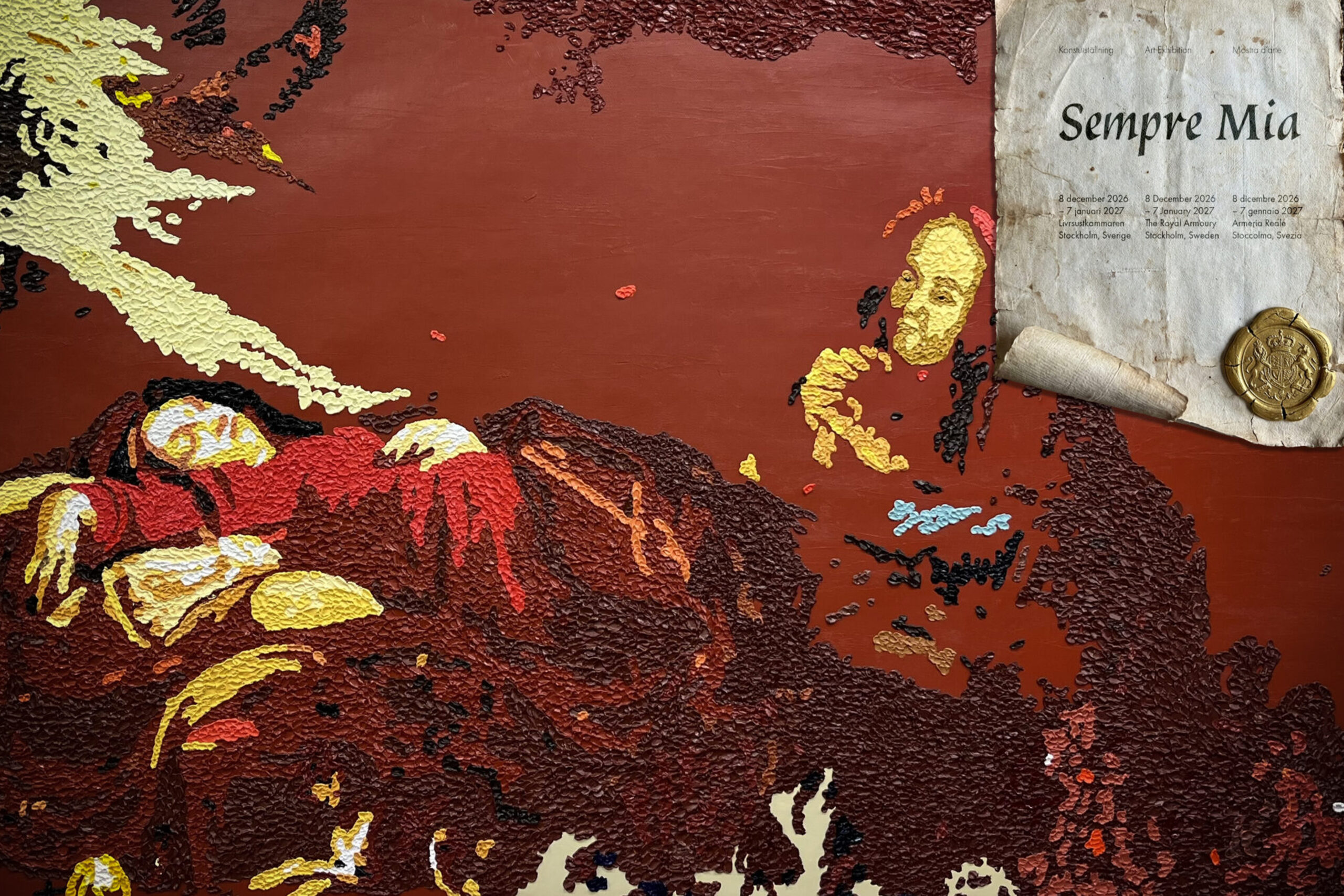
Queen Christina – Sweden’s most powerful and extraordinary monarch – celebrates her 400th anniversary on December 8, 2026.
Exhibition: December 8, 2026 – January 10, 2027
The Royal Armoury (Livrustkammaren), Stockholm.
Queen Christina inherited the Swedish crown after the death of her father, King Gustavus Adolphus, who fell at the Battle of Lützen in 1632. Upon reaching her majority in 1644, Christina assumed power as sovereign of a nation at the height of its imperial age. By the Peace of Westphalia in 1648, she emerged as one of Europe’s leading rulers, presiding over Sweden’s victorious conclusion to the Thirty Years’ War.
Yet on June 6, 1654, in a decision that stunned Europe, Christina abdicated at Uppsala Castle.
She departed Sweden soon thereafter and formally converted to Catholicism in Innsbruck on November 3, 1655. From there she continued south to Rome, making her grand public entrance into the Eternal City on December 23 to the acclaim of nearly 200,000 spectators. At the Pope’s table — though seated one step below — Christina took her place before retiring to her temporary residence, the Tower of the Winds within the Vatican.
From Rome onward, Christina lived as a sovereign unto herself: a court within a court, a state within a state. Though she briefly entertained ambitions of securing a new principality — most notably Naples, in alliance with France — she gradually relinquished the pursuit of another crown. When she closed her eyes for the final time on April 16, 1689, she left behind a life without parallel.
By the time Christina arrived in Rome, she had abandoned the life that had long weighed upon her. At the border she cut her hair and entrusted herself to a hope that would accompany her for the remainder of her days.
And then came what had been one of the deepest reasons for her abdication: love.
On New Year’s Eve 1655, she caught the attention of Decio Azzolino (1623–1689), then thirty-two years old — a young man destined for a meteoric rise within the Vatican and an unusually early appointment as cardinal. There, in Rome, a forbidden love was born, one that would continue to burn long after both had passed from this world in 1689.
In grief, Cardinal Azzolino endured this life for seven weeks and two days after Christina’s death before, in the imagination of eternity, they were reunited.
It is this life — the intimate and everyday moments shared by Christina and Azzolino — that forms the foundation of the exhibition.
Short messages passed between them, carried by couriers from one residence to another, not unlike today’s text messages. One might write while trapped in a tedious negotiation; the other while wrestling with urgent financial concerns — or simply while planning the next day’s excursion to admire ancient sculptures. And no hour was ever too late, nor too early, for a brief message of longing.
Life grants us but a single great love. It is to short for us too experience two.
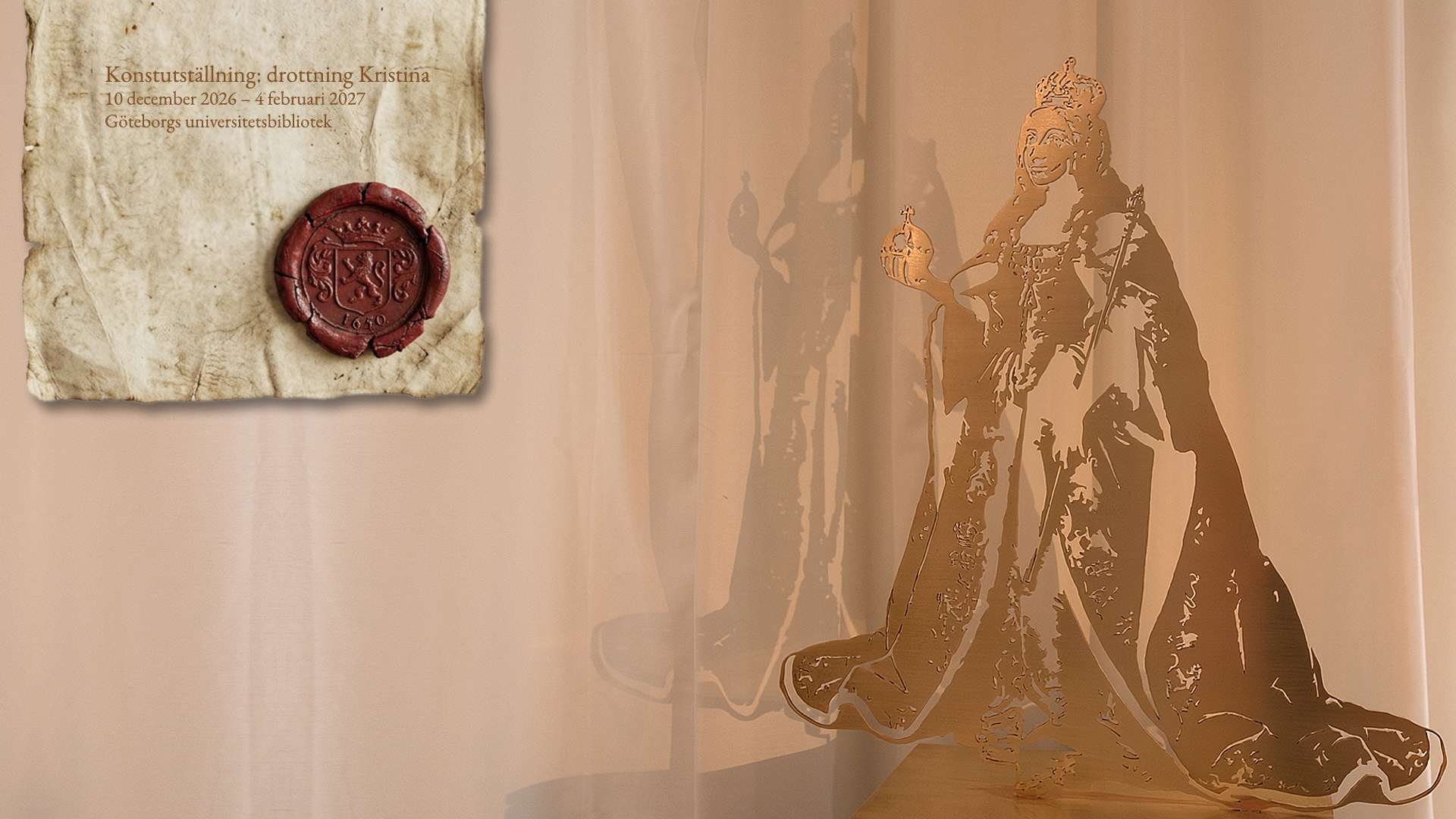
Queen Christina – Makalös and Beyond
On 20 October 1650, Queen Christina was crowned in Stockholm. Cannons thundered across the capital, wine flowed from fountains and banners fluttered above the triumphal arches erected for the occasion. Wrapped in a purple mantle embroidered with crowns, Christina firmly grasped the royal regalia and gazed out over the crowds celebrating their Queen. If only they had known what was to come.
Oh well, she might as well enjoy herself! The coronation became a larger-than-life spectacle of almost unimaginable extravagance. Less than four years later, the Queen would voluntarily surrender the very crown she had so magnificently received.
The exhibition features The Coronation of Christina, a sculpture in brass portraying the Queen in all her royal splendour. Accompanying the sculpture are a commemorative medal celebrating the 400th anniversary of her birth and eight historical lithographs depicting remarkable episodes from her extraordinary life.
Nearly 400 years later, no celebration has surpassed the magnificence of Christina’s coronation.
University of Gothenburg Library
10 December 2026 – 4 February 2027
Welcome!
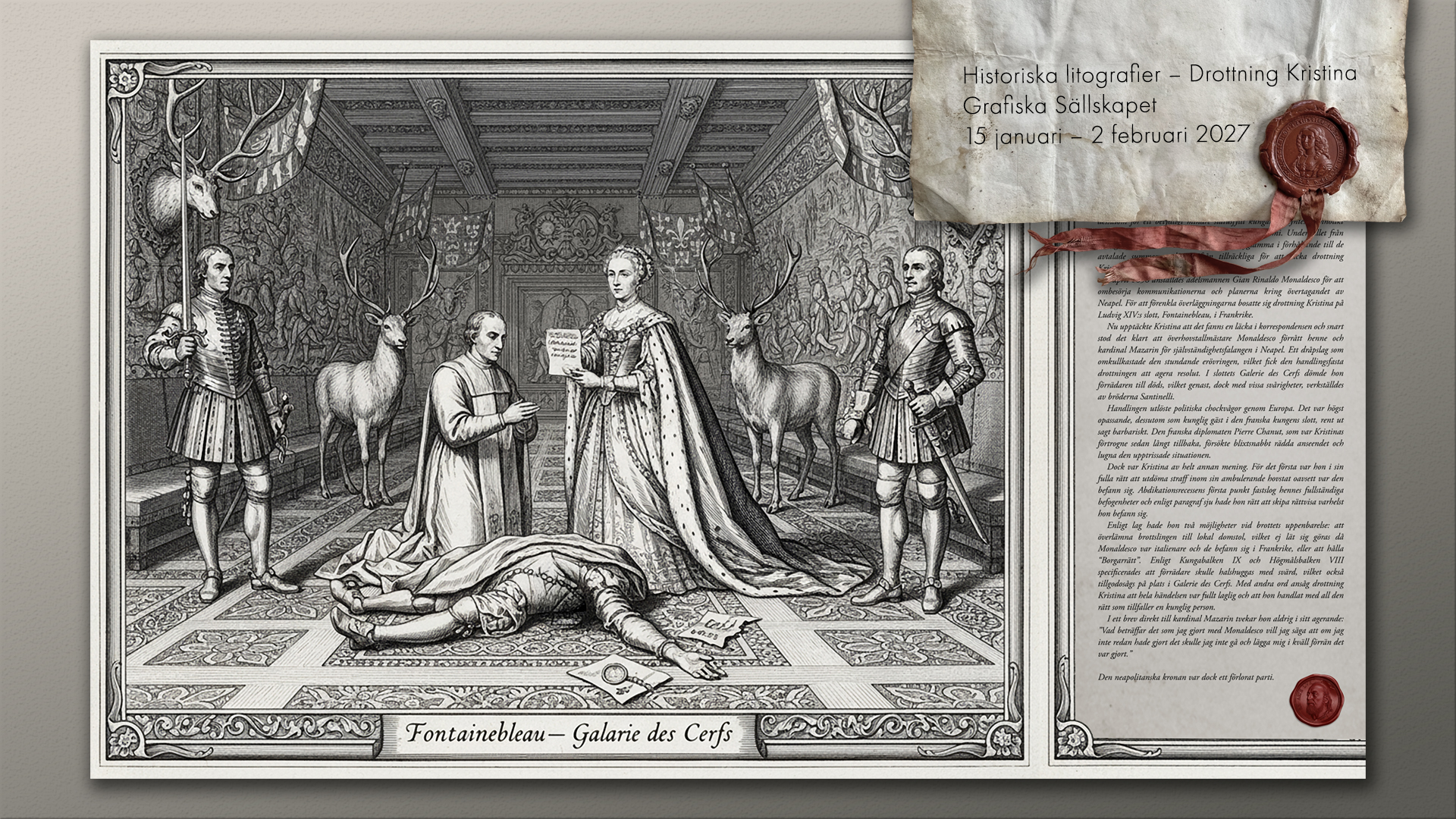
Historical Lithographs – Queen Christina
The Swedish Artists’ Association of Printmakers (Grafiska Sällskapet)
Queen Christina’s life was a clamour of cannon salutes and blaring trumpets. There was always a commotion and never a moment of tranquillity. The exhibition Historical Lithographs brings to light several events that played a decisive role in their day but have since faded somewhat into obscurity.
In the role of Diana, the Queen steps onto the newly constructed stage at the Royal Palace in Stockholm. Christina had imported the tradition of staging grand, lavish ballets from France and the court of her royal brother, Louis XIV. Refining and cultivating the Swedish soul was a seemingly hopeless undertaking, but on 1 November 1649, she stood proudly upon the stage, proclaiming the torments of love and declaring marriage unthinkable for herself.
Eight lithographs revisit the Monaldesco scandal, the celebrations in Hamburg when the wine fountains ran dry — “To my sorrow, I have allowed blood to flow because the wine ran out,” she wrote to Cardinal Azzolino on 3 August 1667 — and, of course, the private horseback ride the Cardinal had wished for, during which they were to admire a number of sculptures that would surely have found a fitting home in the Queen’s casino.
The lithographs are accompanied by a foreword by historian Dick Harrison and were printed at Lumphé Litografiska
Grafiska Sällskapet 15 January – 2 February 2027
Welcome!
In Celebration of Queen Christina (1626–2026)
11 October 2026
Commemorative Medal – Queen Christina 400 Years
• Stockholm Numismatica, Stockholm
18 October 2026
Children’s Book – Queen Christina
• Uppsala Castle Museum, Uppsala
28 November 2026
Children’s Book – Queen Christina
• The Royal Armoury (Livrustkammaren), Stockholm
5 December 2026
Commemorative Medal – Queen Christina 400 Years
• Sigtuna Coin Club – Special Medal Auction, Stockholm
8 December 2026 – 10 January 2027
Art Exhibition – Sempre Mia / Queen Christina
• The Royal Armoury (Livrustkammaren), Stockholm
10 December 2026 – 4 February 2027
Art Exhibition – Queen Christina
• University Library of Gothenburg, Gothenburg
12 December 2026
Children’s Book – Queen Christina
• Bokskåpet Children’s Bookshop, Gothenburg
13 December 2026
Children’s Book – Queen Christina
• Gothenburg City Library, Gothenburg
15 January – 2 February 2027
Historical Lithographs – Queen Christina
• The Swedish Printmakers’ Association (Grafiska Sällskapet), Stockholm

EXHIBITION: KOMPOSITIONS
In December 1911, the artist Wassily Kandinsky published Concerning the Spiritual in Art (Über das Geistige in der Kunst). The text is regarded as one of the foundational theoretical works of abstract art, in which Kandinsky formulates a system for constructing art through colour, sound, and overall composition.
Within this theory, the triangle emerges as a central structure—a spiritual model in which image, sound, and composition interact. For Kandinsky, art is not a representational medium, but an instrument for inner movement and spiritual deepening. The colour blue plays a central role as a carrier of inwardness, depth, and the immaterial.
Kandinsky emphasises that his theories cannot be considered final. Art must continuously evolve and reveal itself over time. It is the task of the artist to carry this work forward.
In my artistic project Kompositions, I have continued working from Kandinsky’s theoretical framework. The triangle, as an artistic foundation, has—more than a century later—been condensed and developed further. The ascending movement that underpins Kandinsky’s system takes on a new form here, and the triangle becomes a pyramid, where image, sound, form, and moving image converge into an expanded composition.